Studying medicine in Malaysia involves understanding more than just which degree to choose. Students need to compare MBBS and MD pathways, check accreditation by the Malaysian Qualifications Agency (MQA) and Malaysian Medical Council (MMC), review entry requirements, estimate tuition fees, and understand how clinical training, housemanship, and registration fit into the full journey to becoming a doctor.
This guide explains how to study medicine in Malaysia, including programme structure, admission criteria, costs, clinical training, post-graduation registration, and specialist progression.
Studying medicine in Malaysia involves pursuing a professional undergraduate degree, specifically either a Bachelor of Medicine and Bachelor of Surgery (MBBS) or a Doctor of Medicine (MD). The MBBS is designed as the first degree to train students across all medical fields. While the MD is often used as an equivalent undergraduate title in various local institutions, it is also sometimes offered as an advanced postgraduate qualification similar to a PhD. To ensure quality, all such programs must be accredited by the Malaysian Qualifications Agency (MQA) and the Malaysian Medical Council (MMC), meeting rigorous global standards.
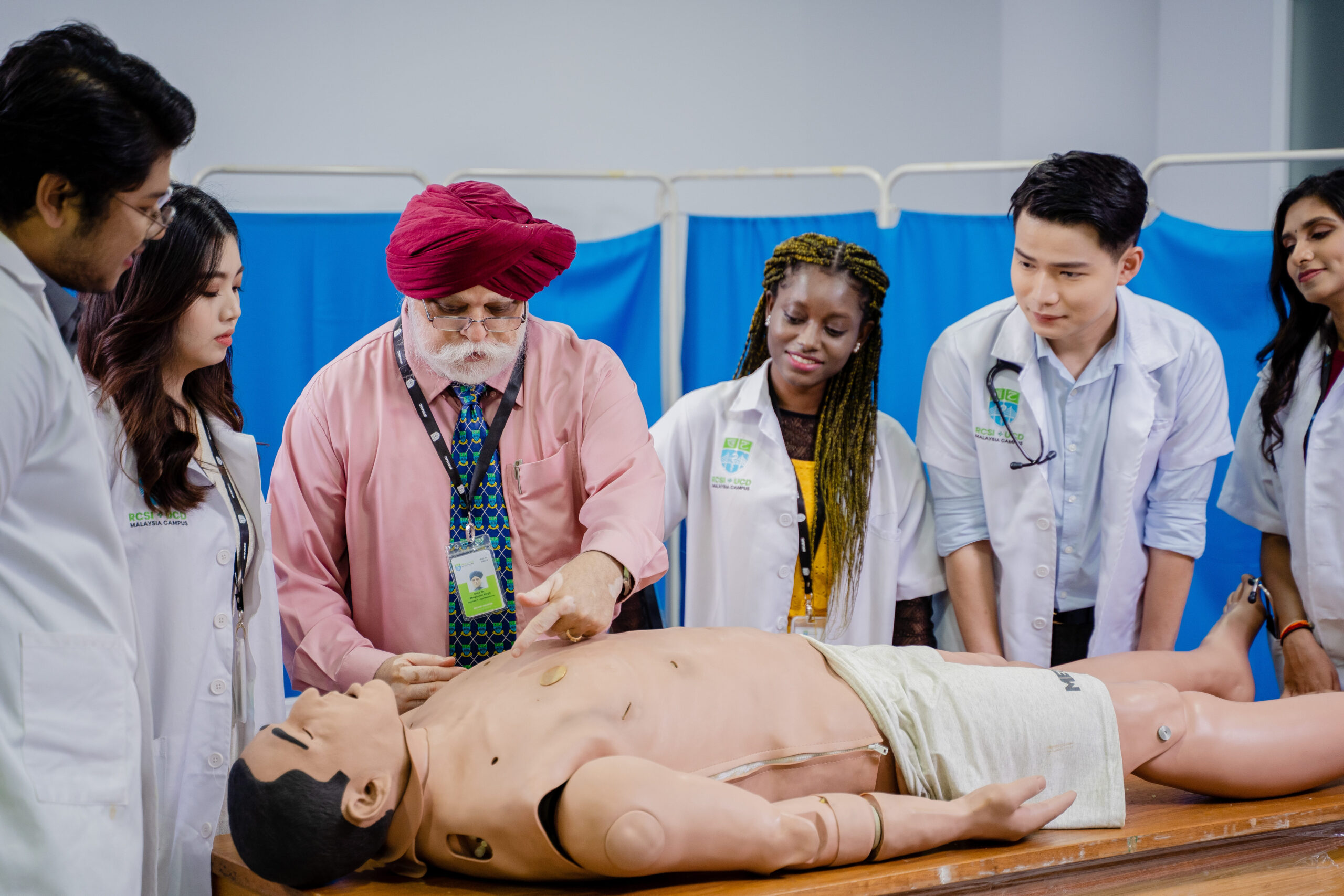
The typical duration for a medical degree in Malaysia is five years. This curriculum is generally divided into two distinct phases to balance theoretical and practical learning. Phase 1, the pre-clinical phase, occupies the first two years and focuses on the basics of medical science, such as anatomy, biochemistry, and pharmacology, in an academic setting. Conversely, Phase 2 covers the remaining three years and emphasises clinical training through rotations at teaching hospitals, allowing students to gain hands-on experience in disciplines like surgery, paediatrics, and internal medicine.
Gaining entry into medical school is highly competitive and requires exceptional academic standing. Applicants must possess a strong foundation in science, typically evidenced by a minimum of 5Bs at the secondary school level (SPM or O-Levels) in subjects including Biology, Chemistry, Physics, and Mathematics. At the pre-university level, standard requirements include achieving grades such as BBB, ABC, or AAC in A-Levels or STPM, or maintaining a minimum CGPA of 3.0 in Foundation in Science or Matriculation programs. International applicants must provide evidence that their pre-university qualifications are equivalent to Cambridge A-Levels to be eligible for consideration.
Beyond academic scores, medical institutions in Malaysia employ rigorous selection processes to evaluate a candidate’s suitability for the profession. Prospective students are often required to sit for entrance examinations such as the Medical Student Admission Test (MSAT), MCAT, or GAMSAT. Additionally, short-listed candidates must typically pass Multiple Mini Interviews (MMI), which assess non-cognitive traits such as communication skills, critical thinking, and ethical reasoning. Proficiency in the English language is also mandatory, with requirements generally set at a minimum IELTS score of 6.0 or a MUET Band 4.
Medical education can be pursued at a variety of public institutions, private homegrown universities, or branch campuses of foreign universities. Tuition costs vary significantly based on the institution type, with total estimated fees for a five-year program ranging from RM 50,000 to RM 650,000. Students should also note that starting in July 2025, a 6% service tax applies to tuition and related fees for international students at private institutions. While many programs are conducted entirely in Malaysia, some transnational campuses offer students the opportunity to spend their pre-clinical years abroad before returning to Malaysia for clinical training.
Upon successful completion of their degree, graduates are entitled to provisional registration with the Malaysian Medical Council. Aspiring doctors must then complete a compulsory housemanship or internship program, which typically lasts two years in government hospitals. Following the satisfactory completion of housemanship, practitioners are eligible for full registration. However, Malaysian citizens are required by law to serve an additional two years of compulsory service within the public health sector before they can enter private practice.
The journey to becoming a fully independent medical professional in Malaysia is a long-term commitment. It generally takes 8 to 9 years after high school to become a fully registered doctor. For those wishing to become specialists in fields like surgery or anaesthesiology, an additional four to five years of postgraduate study is required, followed by two to four years of supervised specialist training. Ultimately, it can take more than 10 years from the start of medical school to become a recognised specialist.
If you are planning to study medicine in Malaysia, it is important to look beyond entry requirements alone and understand the full training pathway ahead. From accreditation and degree structure to clinical exposure, housemanship preparation, and long-term registration, each stage plays a role in shaping how well a medical school supports your future as a doctor.
RCSI & UCD Malaysia Campus (RUMC) is a medical school that offers Malaysia’s only Irish transnational medical degree, combining pre-clinical training in Dublin with clinical years in Penang. Fully accredited by the Malaysian Medical Council (MMC) and Irish Medical Council (IMC), the programme is taught in English, includes early clinical exposure, and opens pathways to international licensure such as AMC and USMLE, alongside scholarship opportunities.
Enquire with RUMC to find out how this pathway fits your study plans, your preferred learning environment, and your long-term goals in medicine.
An MBBS is the standard undergraduate medical degree designed to train students across all medical fields. In Malaysia, the MD title is often used interchangeably for undergraduate programs. However, some institutions offer the MD as an advanced postgraduate qualification equivalent to a PhD.
Applicants generally need 5Bs in SPM science and mathematics subjects. At the pre-university level, requirements include grades like BBB or ABC in A-Levels or STPM. Additionally, a minimum CGPA of 3.0 in a Foundation in Science or Matriculation program is typically required.
The undergraduate medical degree typically lasts five years, divided into two main phases. The first two years focus on pre-clinical sciences in an academic environment. The remaining three years comprise the clinical phase, involving intensive clerkships and rotations within teaching hospitals.
Upon graduating, doctors must undergo a compulsory two-year housemanship in government hospitals. After completing this internship, practitioners apply for full registration with the Medical Council. Malaysian citizens must then serve an additional two years of compulsory service in the public sector.