Choosing the right medical school in Malaysia affects professional eligibility, clinical training quality, financial burden, and long-term career options. A practical way to decide is to follow a fixed evaluation order. Recognition and accreditation come first because they reduce pathway risk, followed by housemanship readiness, then clinical training quality, then curriculum design and outcomes, and finally cost, fit, and future mobility.
This order prevents common mistakes such as relying on branding or rankings while missing programme-level requirements and real training conditions.
This article is intended for general informational purposes to help students and parents organise what to look for when comparing medical schools in Malaysia. It does not replace personalised advice from a qualified school counsellor, academic advisor, or relevant professional body, and it should not be treated as definitive guidance for your specific situation. Always consult a school counsellor first and verify programme details directly with the institution and the relevant authorities before making any decisions or commitments.
Medical school selection in Malaysia must begin with professional recognition and quality assurance, because these determine whether the qualification supports the expected registration pathway after graduation. The Malaysian Medical Council recognition status should be checked at the level of the specific medical qualification rather than assumed from the university name, since recognition can depend on the exact qualification and, in some cases, the campus.
Malaysian Qualifications Agency accreditation should also be verified, with the understanding that accreditation relates to programme quality assurance while Malaysian Medical Council recognition relates to professional recognition. Because promotional materials can use broad claims like “accredited” or “recognised,” the safest approach is to confirm the exact programme status and validity.
Medical education does not end at graduation, so the decision should include a clear view of what happens immediately after completing the programme. Housemanship is supervised training and involves rotations across major departments, which makes clinical readiness a key outcome of undergraduate training. Schools differ in how well they support this transition, so it helps to look for structured preparation, documentation guidance, and readiness-building rather than assuming the pathway will be smooth by default.
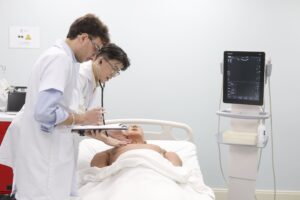
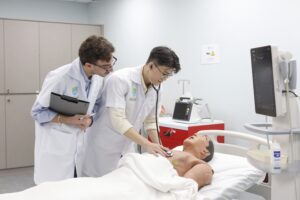
Clinical training quality is one of the strongest indicators of how effective a programme will be in producing housemanship-ready graduates. The evaluation is most meaningful when it focuses on teaching hospitals and clinical sites, because these determine daily exposure to real patients, case variety, and speciality breadth. Stability of hospital partnerships matters because unstable or limited placements can reduce learning continuity. Simulation facilities and structured clinical skills training also matter because they allow repeated practice of core competencies in a safer, more controlled environment before higher-stakes clinical settings.
Curriculum design affects how knowledge becomes clinical reasoning, and assessment design affects how consistently competence is identified and strengthened. Programme structures differ in how they integrate pre-clinical and clinical learning, and they may rely more heavily on problem-based or case-based approaches versus lecture-heavy delivery. Fit matters because learning styles vary, and the same curriculum structure can produce different outcomes depending on the student. Assessment and remediation systems also deserve attention because they show whether the programme can detect gaps early and support recovery when performance dips.
Medical training improves with strong supervision and consistent feedback, so faculty structure is a core differentiator between schools. Clinician educator availability and supervision ratios influence bedside teaching quality and the safety of clinical learning. Mentoring structures and remediation pathways indicate whether the programme supports student progression under pressure rather than relying on self-navigation. Well-being and support services also matter because medical training is demanding, and stable support can affect persistence and performance.
Graduate outcomes provide practical evidence that a programme works, while rankings provide a broad reputation signal that should not override training realities. Useful outcomes include progression patterns, attrition signals, and performance indicators where schools are willing to share them. Graduate pathway information, such as common transitions into housemanship and early career destinations, helps validate the programme’s effectiveness in preparing students for the next stage. Rankings can be used as tie-breakers or context, but clinical competence is strongly shaped by teaching sites, supervision, and curriculum execution, which rankings do not fully capture.
Cost evaluation works best when it includes the total cost of attendance rather than tuition alone. Medical programmes can add clinical-year expenses such as equipment, insurance, and transport between clinical sites, and these should be included alongside living costs. Financing should be evaluated based on scholarship and loan availability, eligibility, merit versus need basis, bonding or service requirements, and withdrawal or refund terms. Practical fit should also be considered because logistics compound stress in a demanding programme, so location, commute, accommodation feasibility, and access to support services all influence daily sustainability.
International mobility becomes relevant when there is a serious possibility of training or working abroad later. The safest approach is to treat portability as something to verify early, because pathway requirements differ by destination and cannot be assumed from general reputation. Confirming compatibility in advance reduces the chance of discovering limitations only after graduation.
If you are comparing medical schools now, use the eight-step order in this checklist to keep the decision practical and low-risk. Start by confirming recognition and accreditation, then evaluate housemanship readiness support and clinical training quality, before weighing curriculum fit, outcomes, cost, and future mobility.
RCSI & UCD Malaysia Campus (RUMC) is a top medical school that delivers Malaysia’s only Irish transnational medical degree, with pre-clinical training in Dublin and clinical years in Penang. Accredited by the Malaysian Medical Council (MMC) and Irish Medical Council (IMC), it is fully English-taught, offers early clinical exposure and scholarships, and supports AMC, USMLE, and global licensure pathways.
Make an enquiry with RUMC to see how this pathway aligns with your checklist, your clinical training priorities, and your long-term registration goals.